

Growth
March 24, 2026
Opening a Company in the UAE Independently: Where Businesses Lose Control

The United Arab Emirates has long ceased to be an “exotic Middle East” for international business. Today it is one of the most stable, technologically advanced and predictable jurisdictions for launching companies. The zero income tax rate in most zones, the possibility of 100% ownership by a foreigner, a developed banking system and the absence of currency controls make the UAE a natural choice for entrepreneurs from the CIS, Europe and Asia.
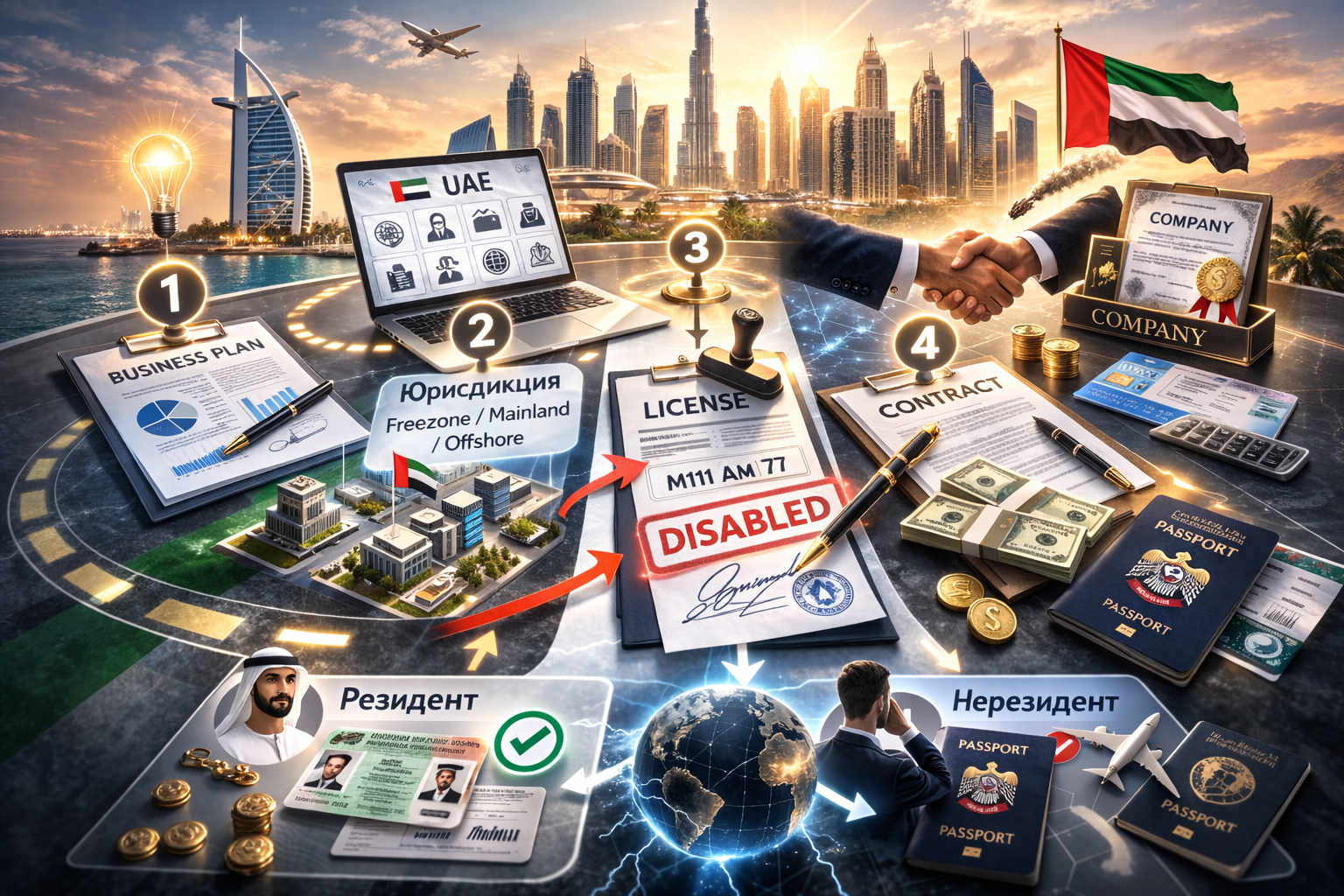
The United Arab Emirates has long ceased to be an “exotic Middle East” for international business. Today it is one of the most stable, technologically advanced and predictable jurisdictions for launching companies. The zero income tax rate in most zones, the possibility of 100% ownership by a foreigner, a developed banking system and the absence of currency controls make the UAE a natural choice for entrepreneurs from the CIS, Europe and Asia.
However, practice shows that most problems arise not at the decision-making stage, but at the execution stage. A bank refusal, an incorrectly chosen jurisdiction, and incorrectly issued documents are not an accident, but the result of a standardized approach. company Lien Advisors, who has more than 5 years of practical experience in business and consulting in the UAE, has built processes that eliminate such risks. In this article, we will discuss step-by-step instructions for registering a business, relying solely on solutions that work and have been tested by regulators.
The first and most important thing is not even choosing a zone, but a clear understanding of what exactly you will do in the UAE.
The variety of business models can be reduced to a few basic scenarios:
Trade (physical goods) — requires a license to import/export, store and resell.
Services (consulting, IT, marketing, education) are the most flexible category; it is possible to work both in the mainland and in the free zone.
E-commerce is a separate type of activity that requires a special e-com license.
Holding activities/asset management - registration in financial havens (ADGM, DIFC).
Production — requires premises, personnel quotas and environmental approvals.
A mistake at this stage makes all the following steps pointless. That's why Lien Advisors does not use template solutions: each case undergoes an initial analysis, including the client's country of citizenship, capital structure, sources of funds and future operating model.
There are two fundamentally different modes of doing business in the UAE: Mainland (a mainland company) and Free Zone (a free economic zone).
Mainland company:
Free Zone:
Some zones (such as ADGM and DIFC) operate under the English Common Law principle and focus on financial services, asset management, and family offices. Others (DMCC, Meydan) specialize in commodities, trading, and technology.
The choice of a zone directly depends on the business model. Lien Advisors selects jurisdiction not “blindly”, but for a specific profile of activity, excluding options that obviously will not pass bank compliance.
After choosing a jurisdiction, work begins with the company name. The UAE has strict naming requirements:
At the same time, preliminary approvals from regulatory authorities are requested - this is especially important for licensed activities (finance, medicine, education, chemical products).
The standard package of documents includes:
It is important: The Emirates accepts documents only in English or Arabic, with an apostille or consular legalization, depending on the country of origin. An error in issuing an apostille is one of the most common causes of delays.
Contrary to popular myth, it is impossible to open a company in the UAE completely remotely. A personal visit by the founders is required to submit biometrics and sign final documents. This is a federal requirement that does not depend on a specific zone.
At this stage Lien Advisors organizes not only legal support, but also, if necessary, corporate rates for flights, hotels and transfers so that the visit is as effective as possible.
This is the most difficult stage for non-residents. UAE banks, especially after increasing compliance, are extremely selective when opening accounts. More than 50% of applications are denied at the KYC stage.
The main reasons for failures are:
Lien Advisors does not just submit applications, but pre-assesses the client's passability, selects a bank for a specific profile and prepares a dossier that excludes formal refusals. We work directly with the compliance departments of the largest banks in the UAE, which guarantees predictable results.
A registered company has the right to issue work and resident visas to founders and employees. Standard procedure:
Investors are provided with long-term visas (3—10 years), but obtaining them requires meeting certain criteria (asset value, business category).
Step 8. Post-registration support
Registering a company is not the finish line, it's the start. Annual license renewal, reporting (even with zero tax), renewal of contracts, HR administration — all this requires either an own financial department or outsourcing.
Lien Advisors stays in touch with the client even after the project is completed. This makes it possible to quickly resolve emerging issues, whether it is a change of director, an increase in the share capital or a regular bank audit.
Critical mistakes to avoid
Why is the result guaranteed only with an individual approach?
The UAE is a country of case law in terms of business administration. What one client did does not guarantee completion by another. Regulatory requirements are changing, banks are reviewing their risk appetite, and free zones are adjusting license packages.
That's why the company Lien Advisors abandoned template solutions. Each case is considered unique: from analyzing the initial situation to choosing a bank and structuring transactions. Direct contracts with government agencies, freezones and banks make it possible to obtain relevant information “first hand” and exclude scenarios in which the client spends time and money on deliberately broken schemes.
The guarantee of a full price refund if the result is not achieved is not a marketing ploy, but a principle of operation that is possible only with absolute confidence in your decisions.
Opening a company in the UAE today is not a question of “is it possible”, but a question of “what is the right thing to do”. The jurisdiction remains one of the most friendly for international business, but entering it requires a professional approach. The step-by-step instructions described above are the base. However, the content of each step with specific content should be determined individually, for a specific business task.
If you're considering relocating your business or starting in the UAE, start with a diagnosis. Lien Advisors Team I am ready to conduct an initial analysis of your situation and offer a realistic roadmap, without excessive promises, but with a clear understanding of how to achieve results.